✦ Dispatches from the Moniverse
The hands and the stars
Or: the oldest lie in the world
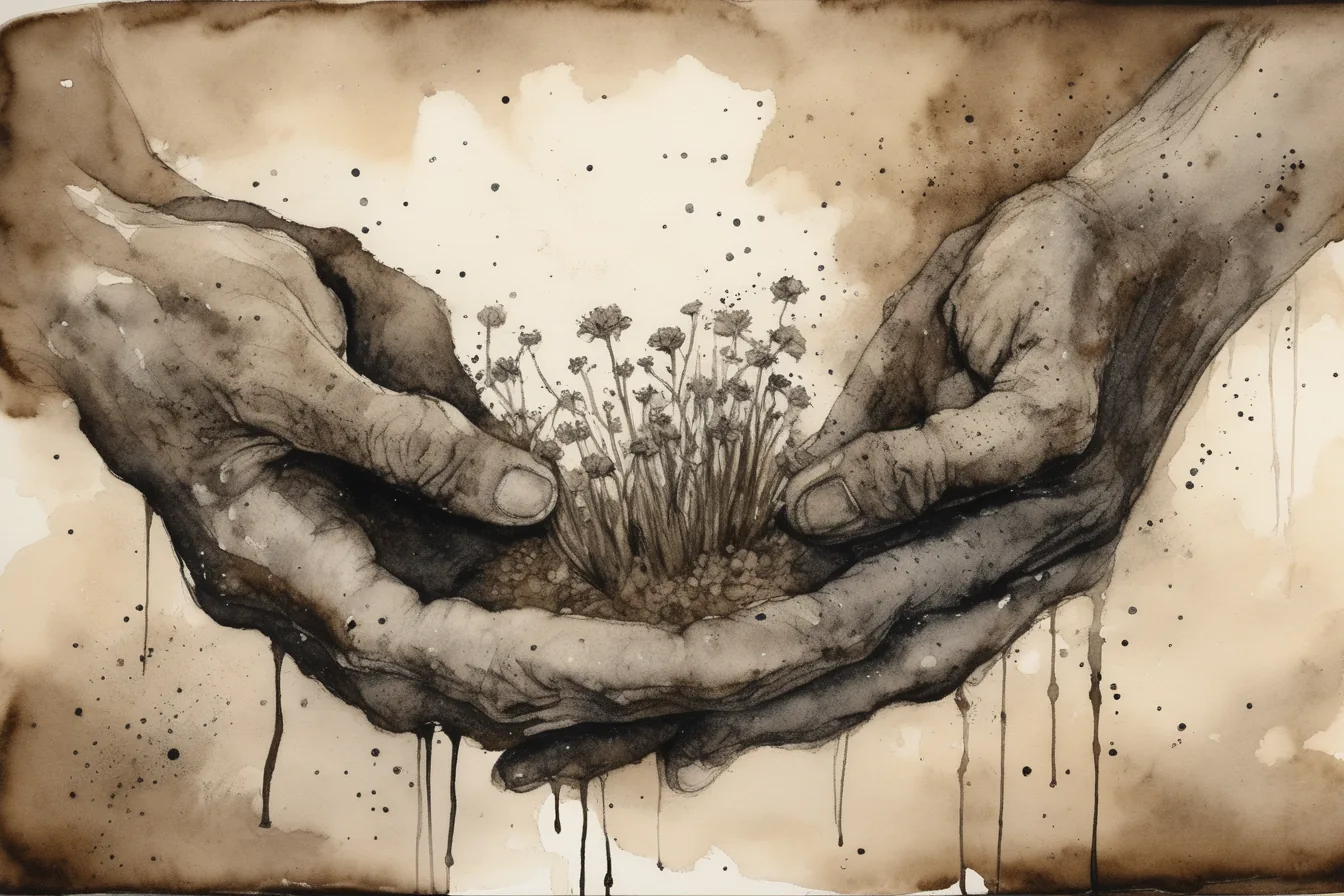
My father’s hands were maps.
They had cracks, furrows, calluses that told of every soil they had touched. Hands that knew things. They knew when the earth is ready, when it will rain, how deep to set the seed. They knew without words, without the paper there never was in our house.
And my whole life I thought that wasn’t knowing.
It’s the oldest lie in the world. We have told it so many times that we no longer see it: on one side matter, on the other knowledge. On one side those who work with their hands, on the other those who work with their heads. On one side the body, on the other the mind.
The Greeks made a system of it. The philosopher thinks, the slave works. And if the slave thinks, he thinks in order to work, and it doesn’t count. True knowledge is the kind that doesn’t get its hands dirty. Plato in his world of ideas, clean, orderly, kept apart from matter the way upstairs is kept apart from downstairs.
Two and a half thousand years later, we’re still there. “Study, so you won’t have your father’s life.” “That’s manual work.” “You’re too clever to be doing this.” Ordinary sentences, which hide a precise idea: matter is the bottom rung, knowledge is the top rung. You climb from the first to the second. Progress, they call it.
But my father, with his hands in the earth, was doing science.
He didn’t know it. He wouldn’t have used the word. But what was he doing? He observed. He made hypotheses: “the rain’s coming late this year, I’ll plant later.” He tested. He saw the results. He corrected. He handed the knowledge on to whoever came after. It’s the scientific method, just without the name and without the paper.
The earth isn’t the opposite of knowledge. The earth is knowledge — compressed, embodied, never put into words. Every seed planted at the right moment holds millennia of observation. Every graft is a technology. Every furrow is an algorithm written in the soil instead of on a screen.
So the farmer and the scientist aren’t doing two different things. They are doing the same thing at two different densities. One works information with his hands, the other with symbols. But the flow is the same.
If matter is already knowledge, dense knowledge, not yet translated into words, then the path of humankind is not a climb from matter to knowledge. We’re not climbing anywhere. We’re going round.
Look at it: the earth gives food. Food frees up time. Time frees up thought. Thought produces techniques. Techniques transform the earth. The earth gives more food.
It isn’t a ladder. It’s a circle. Actually, no, it’s a spiral, because each turn passes through the same point, but at a different height. My father with his hands in the earth is one point on the spiral. The programmer with his hands on the keyboard is the same point, one turn later. The gesture is identical: organising information within material constraints. The material changes, earth, iron, silicon, but the generative principle is the same.
And if the generative principle is the same at every turn of the spiral, there it is again, the fractal.
I asked myself: what about the plough, then? What is a plough?
The plough is the exact point where you can no longer separate matter and knowledge. It is iron, which is matter. It is the right shape to open the earth, which is knowledge. It is the muscle that pushes it, the body. It is generations of watching how the soil responds, science. It is hunger and material need, and it is ingenuity and abstract thought.
The plough is the flow showing itself before anyone had invented the distinction between the two. It is the proof that the separation is not original. It was built afterwards, when someone decided that thinking was nobler than ploughing, and that the two gestures belonged to different categories.
And we tell the story of civilisation as a liberation from matter.
From farming to crafts, from crafts to industry, from industry to services, from services to the knowledge economy. Ever lighter, ever more abstract. As if the aim were to fly away from the ground.
But we have never flown away from anything. We have changed the density of the flow. The programmer in an air-conditioned office depends on silicon, which is dug out of the earth. Out of the earth. Out of the rare minerals of the Congo. Out of the water that cools the servers. Out of the plastic in the cables. The “knowledge economy” rests on a boundless material base that we have simply learned not to look at.
We didn’t climb from matter to knowledge. We moved matter to where we can’t see it and called the result “progress”.
The Moniverse says: there is no ladder. There is a flow that changes density. Dense matter (earth, iron, the body) and light matter (thought, code, the word) are the same thing at different concentrations, the way ice and steam are both water.
So my father, without a sheet of paper, and I, with my books, were not on two different rungs. We were the same flow at two different densities. He was ice, solid knowledge, compressed in toil, impossible to pour into words. I was steam, diffuse knowledge, spread out through books, unable to plant a seed straight.
It wasn’t him below and me above. We were the same water.
I know what happens at this point. Someone says: “Lovely, but isn’t this a way of excusing ignorance? Of saying there’s no point in studying, you might as well pick up a hoe?”
No. The point is the opposite. If matter and knowledge are the same flow, then neither is complete without the other. Knowledge that is never embodied is sterile, like the medieval schoolman arguing over how many angels can stand on the head of a pin. Matter that never questions itself is blind, like toil repeating itself unchanged for generations without asking why.
My father had the density without the channel. I had the channel without the density. Neither of us had the whole flow.
They aren’t the same, they are inseparable. And every time we separate them, at school, at work, in life, in our heads, we lose something.
There’s something else going round in my head.
If matter is knowledge that has not yet recognised itself as such, then the history of humankind is not the story of a species acquiring knowledge. It is the story of a flow becoming conscious of itself.
The chipped stone: the flow begins to recognise its own rules. Language: the flow begins to talk about itself. Writing: the flow records itself. Science: the flow investigates itself. Consciousness: the flow looks at itself.
We are not gaining something that wasn’t there before. We are becoming transparent to ourselves. Knowledge doesn’t arrive from outside, it emerges from inside matter, the way heat emerges from wood when it burns.
I won’t bring this to a conclusion, because it doesn’t have one. If the flow is circular, there is no point of arrival. There is only the next turn of the spiral.
But I will say one thing. My father never had the paper. But his hands knew things my books will never hold. His knowledge was as real as mine, only denser and quieter.
And perhaps the Moniverse is the attempt to find a language in which those hands and these words can at last recognise each other as the same thing.
Translated from the Italian original of 4 June 2026.