✦ Dispatches from the Moniverse
The crooked olive trees
Or: why a child looks at the stars
They had given me a microscope and a telescope for my Confirmation.
I didn’t yet know what to do with them, but I knew one thing: they were for seeing what my eyes alone could not reach. Things too small, things too far away. Someone had decided I needed prostheses to understand the world. And I had accepted the idea without asking myself any questions.
I was one year old when it happened. Or rather, when it all happened at once.
My sister was four and had fallen ill with nephritis. My mother’s father was dying — of something, because that’s how it was then: people died without a name, without a diagnosis, without a single word that might at least let you put a frame around the pain. My mother had already lost her father too soon. And now she was looking at her four-year-old daughter with that same helplessness.
I was one. I shouldn’t have understood.
And yet I always had a stomach ache.
I don’t know if I heard them crying. I don’t know if I felt that silent distance families build around pain when they don’t have the tools to talk about it. But the body of a one-year-old has no filters. It takes in everything, through the stomach.
My father was born in ’33. He used to tell me that when he was a boy there wasn’t a sheet of paper in the house. Nothing to read, nothing at all. He liked knowing things, understanding them, and there was no channel. After the war, matter had got the upper hand: what you needed was food, land, toil. Information was a luxury nobody could afford.
He was a man who wanted to look far off, in a world that asked you to look at your feet. He had taken it on the chin, as people did. My mother wore anxiety like a second skin, not by temperament, I know that now, but because it was the reasonable response of someone who had seen people vanish without explanation and had no reason to believe it wouldn’t happen again.
There were three of us children, one house, the fields.
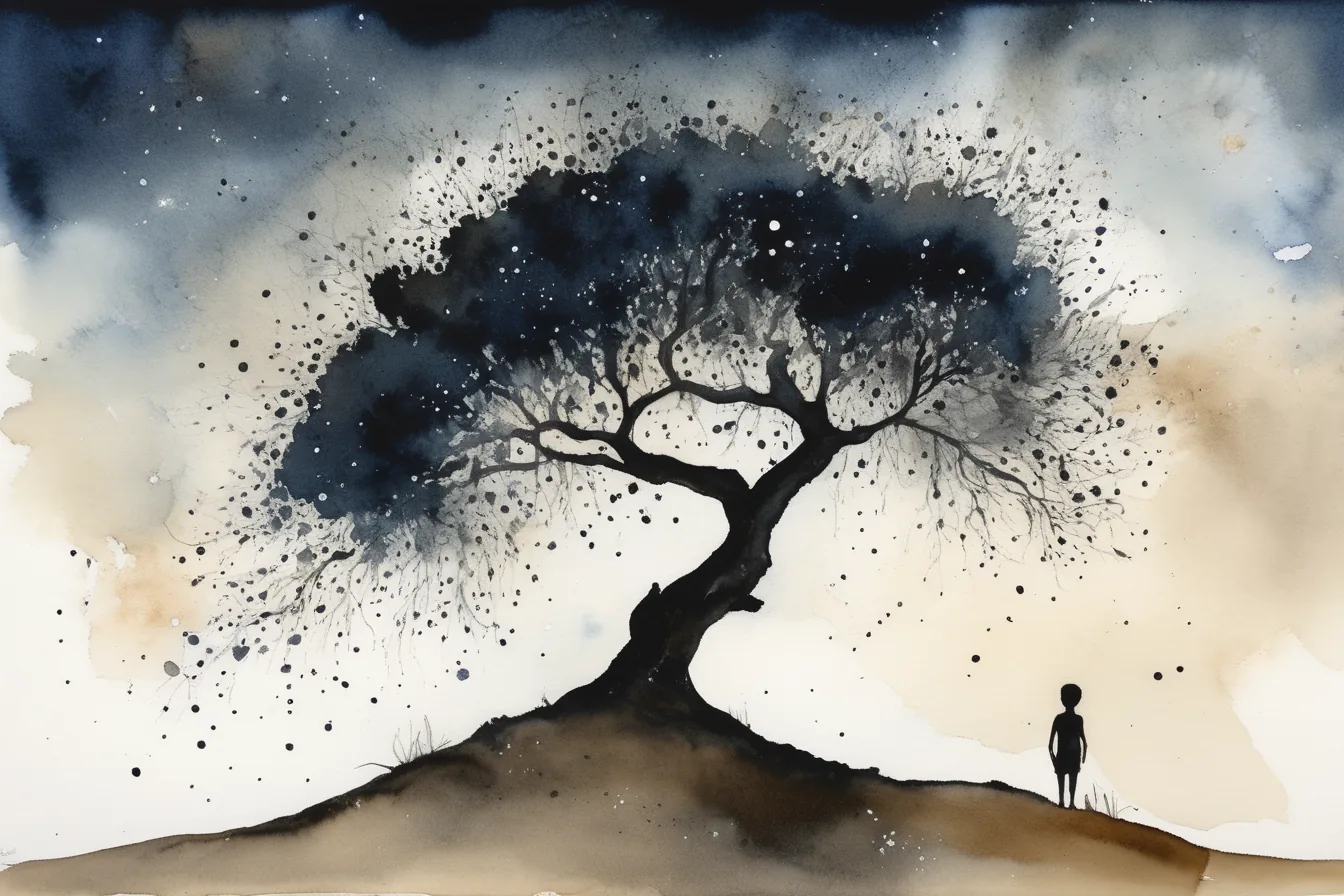
And life had passed over us like a winter frost over an olive grove.
The trees hadn’t died.
A frost can kill olive trees, and it often does. But when it doesn’t kill them, it bends them. It strikes the new branches, the ones that were growing upwards, and twists them out of shape. The tree survives, but the new branches grow crooked, irregular, at angles no botanist would find in the textbooks. It’s the design of a force nobody had invited.
So now I understand why I pointed the telescope outwards.
When the ground beneath you isn’t steady, when people disappear, when your four-year-old sister’s body decides to fall ill, you look for something fixed. The stars were fixed and far away, and they obeyed laws that took no liberties with anyone.
The prostheses worked, and so I raised the bar straight away.
So I took down the Enciclopedia Motta.
Not to read it from the beginning: I had already been using it as a set of weights, one volume at a time, according to how much I could lift. This time I looked up the laws of optics. I read until I understood one thing: the magnification of a telescope depends on the ratio between the focal lengths of the objective and the eyepiece. An eyepiece with a shorter focal length magnifies more. The microscope’s eyepiece had the shorter focal length.
I took the microscope apart. I took out the eyepiece. I held it up to the telescope.
No image formed, because the lenses were too close together. They had to be moved apart. I took a piece of cardboard, rolled it to the right size, and slid it between the tubes as an extension. Then I hunted for the focus, millimetre by millimetre, until the sky stopped being a glowing blob and went back to being something.
There was a price: a narrower field of view, a darker image, some aberration at the edges. But the magnification had doubled. And at that magnification, Saturn was within reach.
The bathroom at home had a small window, forty centimetres by fifty, perhaps. But it faced the right way: in the evening, at a decent hour for a schoolboy, Saturn passed right through it.
I set myself up there with the modified telescope, the cardboard tube in the body of the instrument, and aimed at the rectangle of sky.
Saturn had become incredibly fast.
With those optics the field of view was so narrow that the planet crossed the eyepiece in a few seconds, and you had to chase it, correct all the time, keep it in the centre while it ran for the edge.
And when I managed to hold it still for a moment — three spheres in a row. The one in the middle bigger, the two at the sides smaller, squashed, misshapen. Not the magnificent rings of the photographs. Three small grainy circles in the dark, degraded by the home-made optics.
But they were the rings of Saturn. I had found them on my own, with a cardboard tube and the Enciclopedia Motta.
It worked.
My father hadn’t even had a sheet of paper, and he was looking for something he couldn’t reach. I had been given two optical instruments, and as soon as I reached something I was looking for something beyond it.
Life had passed over us like a frost. The trees hadn’t died.
Translated from the Italian original of 4 June 2026.