✦ Dispatches from the Moniverse
Subtraction
Or: a calculator with only one key
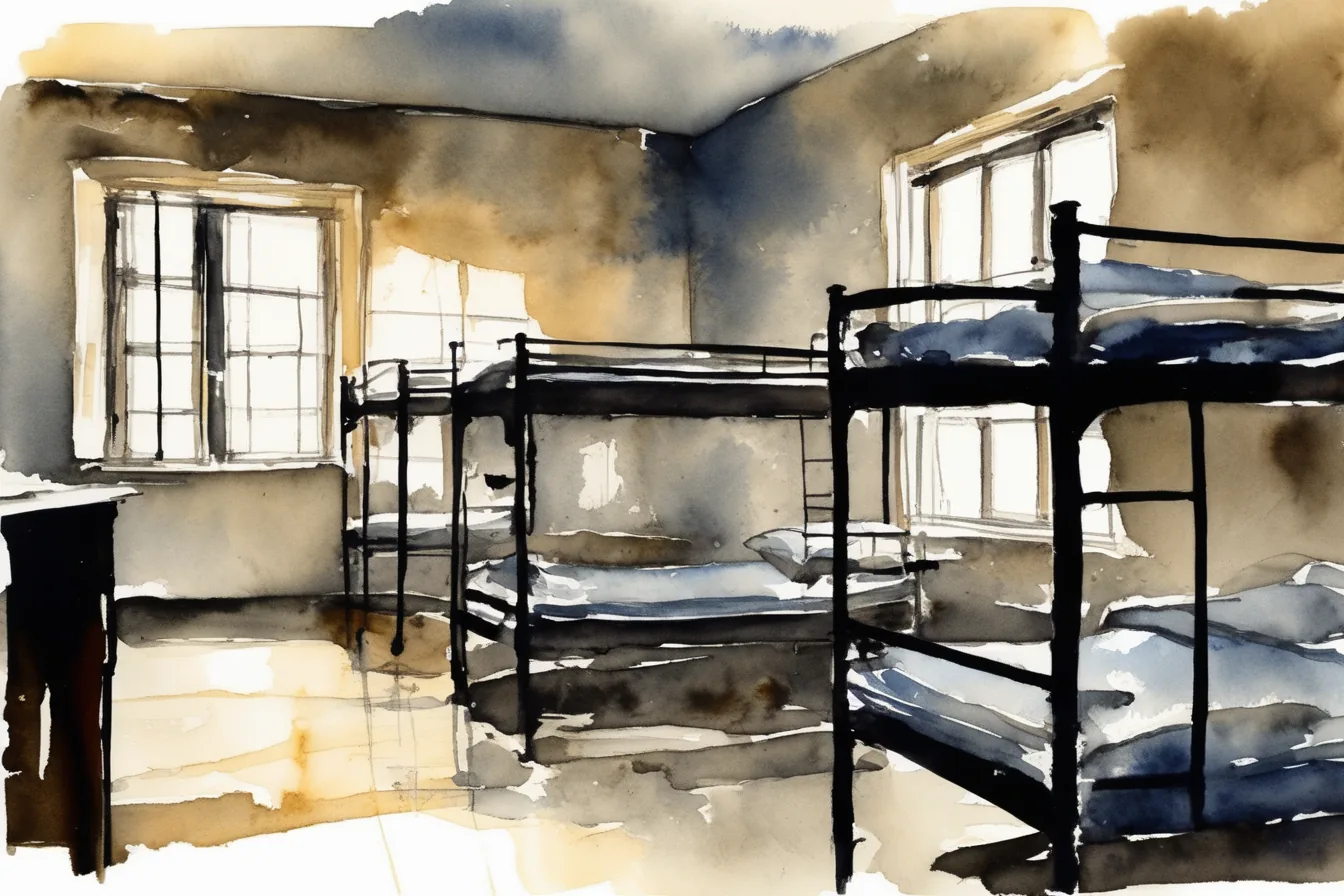
A moment before you open your eyes you could be anywhere.
Suspended at that exact point where the room isn’t a room yet, the bed isn’t a bed yet, and you aren’t anyone in particular yet. It could be your own bedroom, with the right light and the right sounds of the house. It could be any place, at any time.
Then you open your eyes and the world decides.
Herringbone tiles, terracotta-coloured, polished with red wax and patched here and there in a slightly different shade. An enormous cast-iron radiator, the kind that weighs as much as an anchor. A window with fifteen or twenty coats of white paint, one on top of the other, like the geological eras of a building nobody ever felt like sanding down. Six bunk beds. I’m on a top one.
A boy is standing still beside the bed opposite, just as confused. We look at each other without saying anything, there’s no need. We both know we are not where we ought to be, with the disbelief of someone who wakes up and, for a moment, hopes he isn’t quite awake.
But it’s all real. I’m in a barrack room of the Recruit Training Centre, 11th Company, 3rd Platoon, 17th Squad, at the Ignazio Vian barracks in Cuneo, Alpini, Mondovì.
The day before, I had been at a railway station with a holdall and a sheet of paper.
I wasn’t nineteen yet. I had left school, and without that piece of paper you couldn’t put anything off: they called you up and you went. In my pocket I had a letter from the village priest. A few lines written from the height of his parish authority, begging my future superiors to grant me leave for my sister’s wedding, two weeks away, when a recruit isn’t yet entitled to go home.
Saying goodbye to my parents. I don’t remember who turned away first.
The train for the training centre in Cuneo meant a change at Genoa, then, I think, at Turin. But it didn’t matter where, because at every stop the train picked up others like me. You recognised them without having to ask: same age, same holdall, same short hair, same lost face. Clones. Twin brothers who had never met. And out of that recognition came a friendship that was forced and yet sincere, like between people in the same rubber dinghy.
One of us was standing still under a mechanical departures board. The kind with flaps that turn over — clack, clack, clack — letters and numbers changing without a pause. He stood under it as if hypnotised. Every so often he swayed slightly, like the flaps. He didn’t move from that contemplative position.
A travelling companion I had met a little earlier and I looked at each other, and without a word we went over to him, the way you do with someone who has stopped in the middle of the current and could be swept away. A hand on his shoulder. We asked him where he was going.
He said: “Hi, I’m Ebro. I’m going to Cuneo.”
We sat down in a compartment to compare our call-up cards. Ebro and I had the same destination. We agreed with the others: when we got to Cuneo, we wouldn’t report straight away. First a look round like tourists, an hour, maybe two, enough to say we had seen the place.
The moment our shoes touched the platform beyond the step of the train, we heard shouting. “Oi, you lot, where are you going?” A moment later we were sitting on the side bench of an army lorry that seemed to be driven by someone with a score to settle with the pedals. Ebro looked out through the canvas. He didn’t say anything.
At nineteen the body is a concentrate of efficiency and mobility. You can forget about it. You don’t feel the cold, you don’t work out how to get down from the top bunk, you don’t think about where you put your feet. It is so full of itself that it makes no noise, and all your attention moves outwards, towards the people in the room and that noise of shouting that comes ahead of whoever is about to walk in.
We had met Corporal Fois the day before, when, still in civvies with our holdalls beside us, he had herded us into platoons as best he could. Thin, dark, about twenty-five. He had started out like us a few years before and then signed on for longer, turning his national service into a fixed-term job. A “signer-on”, as people said, and it wasn’t a compliment. His uniform was neat but lived-in, with small departures from regulations: hair a touch longer than ours, a detail on his belt, things we didn’t yet know how to read but which said “I’m inside, you’re guests”.
He spoke in a tone that didn’t shout but wasn’t open to discussion. The first rule he gave us was this: when a superior freezes you with an order to stand to attention, only he can release you. And if he dies — he said, without changing his expression — you stay like that for ever.
Nobody laughed.
You fall asleep a son. You wake up a recruit.
For a month reveille came in the dark, shaving in cold water, hours standing motionless on the parade ground with your back straight and your eyes fixed on a point chosen by someone else. The body learned to move on command, to stop on command, not to exist between one command and the next. A hundred individuals turned into a mechanism with two hundred legs and a single receiver.
Then the oath. A sentence spoken aloud in front of a flag, and the mechanism went back to being people. My limbs were my own again. Posting: 4th Signals Battalion “Gardena”, Bolzano.
That was where I met Massini.
He wore glasses and was a few years older than us, three or four, which at that age make the difference between those who take it and those who watch. We weren’t friends in the strict sense of the word. He was one of those people you follow without knowing why, with a magnetism that ninety-nine per cent of us didn’t have.
On our evenings out we walked a lot, because we were on foot and a nineteen-year-old’s knees could take a whole day of it. We went looking for something to eat that wasn’t barracks food. Massini had scouted the territory on his own, and before any of us could walk into it face first he warned us: in a lot of places they wouldn’t be glad to serve us. In some they wouldn’t answer us in Italian. In Bolzano, in those years, part of the population didn’t look kindly on the presence of Italian soldiers, and a uniform was already a provocation.
There was a lot of talk about hazing by the old hands. People said things, people knew things. They were rumours, and rumours often work better than reality when it comes to frightening you. In practice, the most concrete form of it I ever saw was a bed block pulled apart. The bed block was the geometric shape you gave your mattress every morning, with all the bedding folded on top, and it had to stay intact until evening, so the bed was out of use for the whole day. Somebody would come past and pull it apart. Between absurd rules and sabotage by your own comrades, the line was a thin one.
Some people challenged the system from the inside, like a fellow soldier who was a lawyer and had read up on everything the army was meant to give us and caught them out over the shortfalls in the rations. Not Massini. Massini didn’t challenge anything. He had sublimated the stress of national service in a way that, for us, was a mystery to be solved. He said we were like someone working on the rind of a cheese, scraping it, smoothing it, tending it, and then throwing the cheese away. The rind was the rules, the bed block, the uniform. And the cheese we kept throwing away.
On one of our outings we were walking as usual, with no plan, because in national service you didn’t make plans. At a certain point, on the left side of the road, we spotted the entrance to a cemetery. Massini was in front. He rambled something about a visit being compulsory and slipped inside. We followed him without too many questions, as if it were normal.
It wasn’t a war cemetery with neat rows of white crosses. It was the cemetery of Bolzano, in the town, with old headstones, grey stones, names and dates. We turned into walking calculators with a single key: subtraction. Year of death minus year of birth. Year of death minus year of birth. Year of death minus year of birth.
The answer was almost always somewhere around our own number.
And at some point you stop in front of a headstone and the question changes. It is no longer how long he lived. The question becomes: what decided that at this moment I am reading a name and two dates, while that boy my own age, in some cases a seventeen-year-old, is there, under the stone, still, motionless?
Or perhaps he was looking at me. From his silence, with all the weight of what he had done, he was watching this boy standing up with his fears, in a uniform like his, with his body intact.
I felt a deep respect. The respect you feel for someone who was your age and didn’t get your time.
The meadows along the Talvera were green and the grey of the headstones stopped at the gate. Life didn’t wait for us to finish counting.
We went to a pizzeria. We ate a pizza and drank some red wine. At nineteen you can’t stay still, you can’t keep your body and your thoughts frozen for too long, because the body won’t let you and puts you back in the current. We kept turning our heads after a girl out for a walk.
Death and a margherita on the same evening.
Forty years on, that subtraction key is still there.
Translated from the Italian original of 4 June 2026.