✦ Dispatches from the Moniverse
I feel funny
Or: the wrong map that saves your life
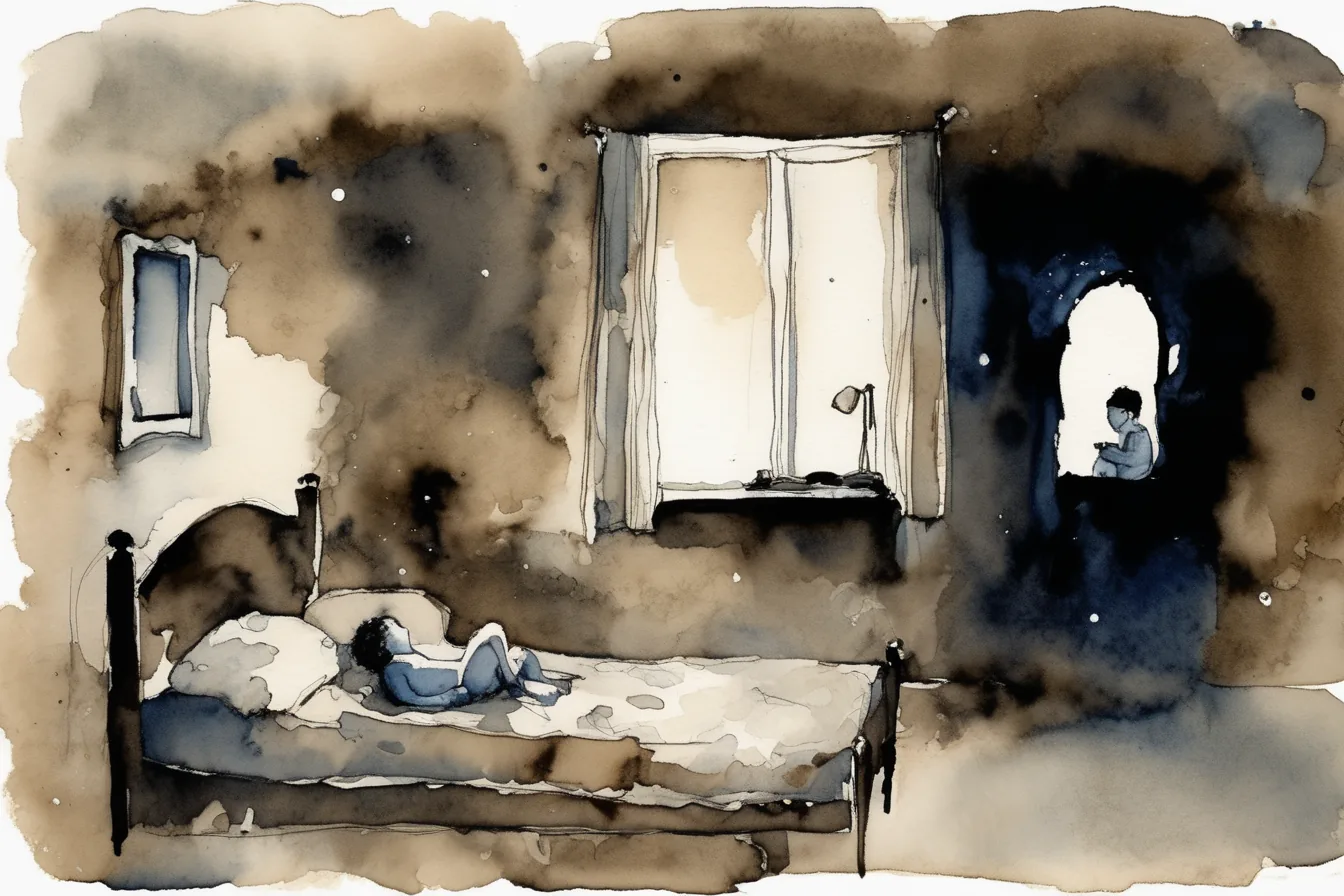
There’s a woman sitting in my bedroom.
Her name is Bice, a short, decisive name, a sorceress’s name. She has come with a chauffeur, and the black car has stayed at the entrance to the courtyard, in front of Beppa’s house, because the dirt lane that leads to us isn’t an S, but towards the end it turns into a Z, and the last bend is too tight unless you have the patience of a resident trying to get to his own front door. So she got out and did the rest on foot, like a diva crossing a stage, along the S-Z of beaten earth to our house at the far end, the one with the fields behind it as far as the eye can see, all the way to the hills. That car in the courtyard was a spaceship landed in a henhouse. Behind the windows the curtains twitched as she went by. In a courtyard of fewer than ten families, everyone saw. Nobody said anything.
In the house my father stands with his hands at his sides, those hands that know everything about the earth and nothing about this. My mother beside him, with the look of someone who has handed the problem to someone who might know how to solve it. And me on a chair, eight years old, with my “I feel funny”.
Bice is wearing an elegant dark dress, a dress my mother would never wear. She comes from another world, from a life that isn’t spent in a courtyard with a Z-shaped lane. When she opens her mouth her voice is hoarse, with the rasp of someone who has talked a great deal, or smoked a lot of cigarettes, or both.
Before saying anything about my problem, she talks. She tells of impossible cases she has solved. Doctors who came to her for advice. She holds the centre of the room with the precision of someone who knows exactly how much space to take up. My parents listen to her the way you listen to someone who knows. My father, the man without a sheet of paper, the hands that knew everything about the earth, becomes a child himself in front of Bice.
I’m at the centre of the scene but I’m invisible. It’s a conversation between adults, and since the evil eye comes from outside there’s no reason to speak to me directly. Like a patient asked to step out of the consulting room while the medical staff deal with the pathology. I’m sitting on the chair, the dark dress in front of my eyes, the hoarse voice in my ears, and nobody asks me anything.
Outside, the chauffeur waits.
People said Bice had lost her parents in the war. A woman who had gone through loss and come out the other side with something others recognised as power. She did good in a way that wasn’t in the textbooks.
But to understand what she is doing in my bedroom, I have to go back.
The fear came in the evening.
During the day it hid under homework, under games, under all the things that keep a child’s head busy. But in the evening, when we were getting ready for bed, the day ended and the noise ended with it. And in the silence the fear grew strong.
It wasn’t fear of something. There was no monster under the bed, no noise from the road. It was a note out of tune inside my head, interference, like a badly tuned radio you can’t switch off. My bedroom became another place. The same bed, the same shelf with the books, the same desk for homework, the same little picture of the Madonna on the wall — but everything slightly shifted, like a blurred photograph. The Madonna looked down at me and I found no protection in her. She was an eye open in the dark.
There were two beds in the room, mine and my brother’s; he was five and slept soundly. Two beds with their heads under the window and their feet towards the door. The same dark for both of us, but we weren’t in the same dark.
And I lay there with my senses on alert, the way you do when you’re waiting for someone who’s late and you strain towards footsteps that don’t come. Only I didn’t know who I was waiting for.
“I feel funny.” It was the only thing I could say. I already knew, with that silent logic of children who grow up in families where nobody cuts a poor figure, that what I felt was not something you could put on show. You stood up straight, you were tidy, you were dignified. The fear was there, but it wasn’t shown. And “strange” was the right word, vague enough to be sayable, true enough not to be a lie.
I followed my mother round the house. I asked her if we could have a chat. Not “I’m scared”, you don’t say that. “Can we have a chat?” We talked about school, about homework, about practical things. She listened. The days went by and her worry grew.
At night, when I couldn’t sleep, I heard my parents whispering through the thin wall of my bedroom. For hours, always in tune with each other, with pauses for thought followed by more whispering. I couldn’t make out the words, but the rhythm was reassuring: two people thinking together in the dark. Whatever answer there was, I knew, would start from there.
But a child’s mind can’t bear a fear with no name. It needs a container to pour it into, and mine came from the TV.
Television had only just come into people’s homes. Black and white, the first window onto the world inside the walls of the house. And the TV told of kidnappings, of the Anonima Sequestri or something like that. Gangs who kidnapped rich people and demanded ransoms. I didn’t really understand what a kidnapping was, but I understood enough: it was something that happened to you. Someone came and took you away.
So the fear finally had a name: they’re going to kidnap me.
From there the mechanism started up, with the iron logic only a child possesses.
A kidnapper was needed. I found him at the petrol station near our house: a tall, big man. The only features required to build a villain. He was the ringleader. Obviously.
I started avoiding the petrol station when I went out on my bike. I ran into him at the supermarket, and of course he was following me, he was planning the kidnapping. I saw him again in the street — final confirmation.
The story I told myself held together, not a hole in it. Except that it was built on nothing. That man had never hurt a fly. His only crimes: being tall and big, and filling up at the wrong petrol station.
And my family wasn’t rich. Not at all. Who knows why they would have wanted to kidnap me. But I had an answer for that too: maybe they’d made a mistake, got their sums wrong. That’s fear’s trade: script, direction and production, all in one head.
Did I believe it? Yes. Did I know it was absurd? That too. I held the two things together without letting them touch. The kidnapper was real and the kidnapper was ridiculous, and that wasn’t a problem, because nobody was asking me to choose. The map was wrong. But with a wrong map I was better off than with no map at all. The boy who gave the petrol station a wide berth on his bike at least had something to avoid. The boy who “felt strange” had nothing.
In the end the whispering behind the wall produced an answer.
Not the doctor. Not the psychologist, that was how it was, at that time, in that neighbourhood, with those means. A wise woman. She came out of those nights when my parents were looking for a way out in the only way they knew.
The diagnosis was the evil eye: the harm came from outside.
Bice explained that she could identify ailments by examining vests, the ones worn next to the skin. The body writes on the fabric; she reads the fabric. Like an X-ray, she said.
There was nothing mysterious about it. Bice talked, she explained how the world went and how she had found a way of putting things right.
Then she prescribed something practical. Rites and prayers, which served to instil the awareness that a way had been opened. And a concrete remedy: light a candle when you go to bed.
The candle stood on a kitchen plate.
Not a candlestick, an ordinary plate, one of the ones we ate off at supper, set on the bedside table between the two beds. My mother got it ready every evening and I found it waiting the way I found the soup waiting in my plate. No ceremony: just another gesture between laying the table and turning off the light.
The first evening I looked at it for a long time. The warm light filled the room and I felt one precise thing: someone had acted. Bice was sure, and her sureness burned on the bedside table along with the wax. The ailment would be driven out.
The obsessions grew quieter and quieter, not all at once, night after night. The out-of-tune note faded. The plate with the candle between the two beds, my brother asleep, accepting whatever the grown-ups decided (including yours truly, who at eight was already “the grown-ups” to a five-year-old), and me watching the light and feeling the silence go back to being only silence.
It lasted about a week. Ten or so candles, replaced before sleep, one after another, like medicine. Then at some point it wasn’t needed any more. There was no precise moment, nobody said “not tonight”. The cure slipped by the way the fear had come, without announcing itself.
My mind had mobilised the whole of the Anonima Sequestri. A match was all it took.
Translated from the Italian original of 4 June 2026.